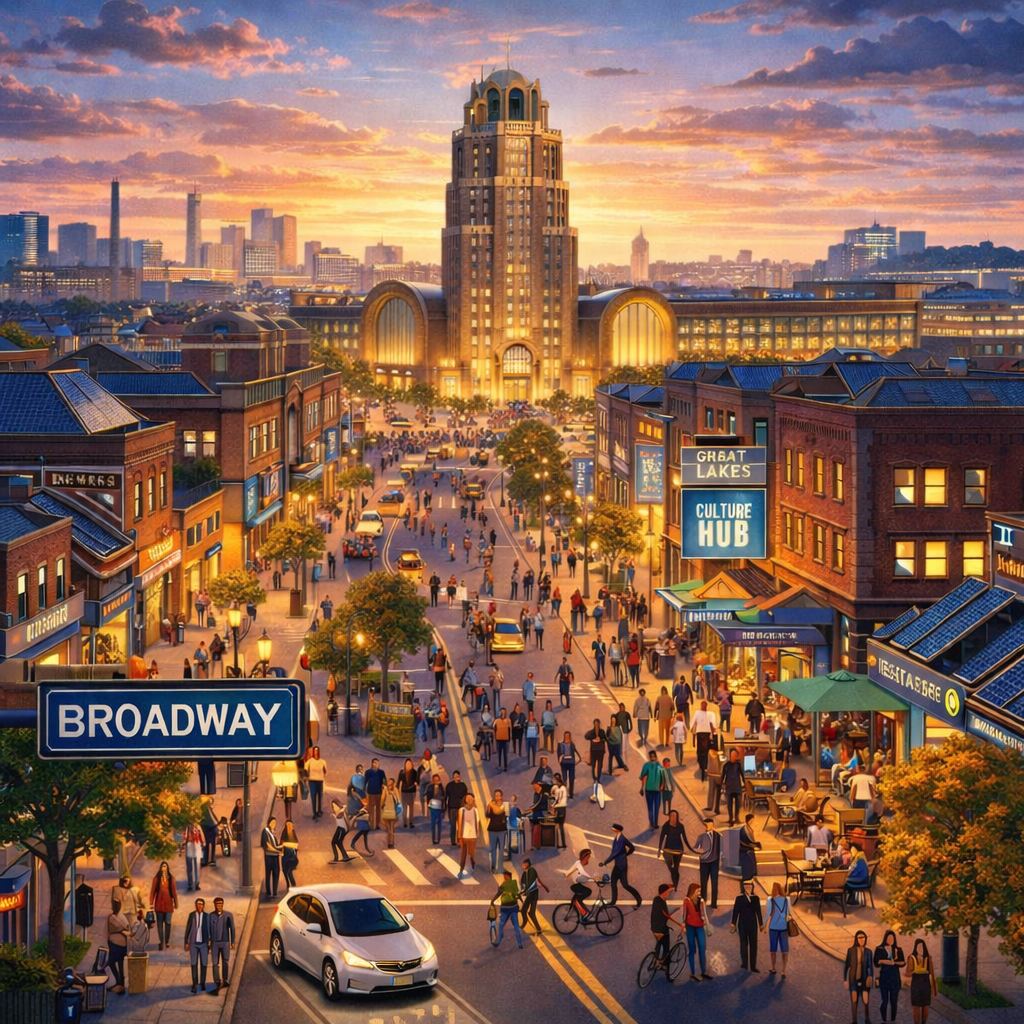
By 2040, Buffalo’s East Side had become a national model for urban revival because it solved three problems at once. The neighborhood’s nearly 1,800 vacant lots, long seen as a symbol of decline, became the canvas for something the country urgently needed: affordable housing built by local workers, a clean energy workforce trained for the jobs federal policy was creating, and a food system that actually fed the people living there. Buffalo had the land, the location, and the community infrastructure to do all three together.
The anchor was the Central Terminal. Fully restored by 2036, it reopened as the Great Lakes Workforce and Culture Hub, a working building with a clean energy trades training center, a culinary and food systems school, a maker space for advanced manufacturing, and a public cultural archive preserving both the neighborhood’s Polish roots and the stories of the Burmese, Puerto Rican, and Congolese families who had kept the East Side alive through its hardest decades. The grand concourse hosted union graduation ceremonies, Dożynki harvest festivals, and Burmese New Year celebrations. St. Stanislaus ran Polish language classes on Saturday mornings and ESL classes on weekday evenings. The Broadway Market was full again.
The neighborhood around the Terminal had been rebuilt carefully and deliberately. The Erie County Community Land Trust, funded in 2027, acquired 1,800 parcels before outside investors could, holding the land in community ownership permanently. On those parcels, 1,400 homes were built or substantially renovated by apprentices trained through the Terminal’s own workforce pipeline, learning on real buildings in their own neighborhood and earning union cards when they finished. Four neighborhood schools were redesignated as full-service Community School Hubs, with health clinics, adult education, and after-school programs. Families who had left the East Side in earlier decades had the right to return. More than 200 did.
Alternative Futures
- Growth: The community land trust model and Terminal workforce hub attract federal designation as a national replication pilot, drawing $400 million in additional investment over five years. 43North relocates its competition and accelerator infrastructure to the Terminal campus, seeding a clean energy and food tech startup corridor along Broadway. The East Side becomes a genuine innovation district built on community ownership from the start.
- Collapse: The land speculation window closes before the Erie County Land Trust is adequately capitalized. Outside investors acquire more than 1,200 parcels in Broadway-Fillmore and Genesee-Moselle between 2026 and 2028, banking land for a decade while the surrounding community hollows out. The Central Terminal stabilizes structurally but never achieves the capital campaign needed for full restoration. ECMC’s financial crisis deepens, eliminating overnight emergency services from the Medical Corridor. The East Side becomes a cautionary tale about good ideas that arrived too late.
- Constraint: The land trust is funded at half the needed scale, protecting roughly 600 parcels rather than 1,800. The Terminal partially restored and the grand concourse opens, but the workforce training center operates well below planned capacity due to state funding gaps. Improvement is real but uneven: North Broadway-Fillmore stabilizes while Genesee-Moselle and MLK Park continue to lose population. One school receives Community Hub designation rather than four. Progress is genuine but fragile, vulnerable to the next budget cycle or political shift.
- Transformation: A sovereign wealth fund, drawn by the same freshwater logic reshaping Niagara Falls, NY, acquires a 20-acre parcel on the eastern edge of the corridor and proposes a global climate adaptation research campus anchored by the University at Buffalo. The East Side’s community land trust negotiates a binding community benefits agreement giving residents an equity stake in the campus and first hiring rights for 40 percent of positions. The neighborhood becomes a node in a global network of freshwater and climate resilience research, attracting international talent and redefining what Buffalo means to the world.
Signals This Draws From
- East Side vacant land concentration (84% of ~7,400 city lots)
- Central Terminal Restoration Corporation’s long organizing history
- Open Buffalo Urban Ecology Campus as proof of concept
- Federal clean energy workforce investment (Inflation Reduction Act implementation)
- Buffalo’s climate haven identity and first population growth in two generations
- Polish heritage institutions: Broadway Market, St. Stanislaus, the Terminal itself
- Immigrant community anchors: Puerto Rican, Burmese, Congolese, African American
- Aging WNY housing stock and the rehabilitation backlog
- Buffalo Public Schools chronic underfunding
What Had To Be True
- The Erie County Community Land Trust had to be capitalized and empowered to acquire land before the speculation wave, the 2027 intervention was the decisive hinge point
- The Central Terminal had to receive federal workforce infrastructure designation, unlocking capital the Restoration Corporation alone could not raise
- Community benefits agreements had to be legally binding and enforced, giving existing residents first access to jobs, housing, and commercial space in everything built on trust land
- The school redesignation required a sustained 10-year funding commitment from the district, state, and federal government
- Polish cultural institutions and current immigrant community organizations had to hold governance seats in the Terminal’s programming board and the Land Trust’s decision-making structure