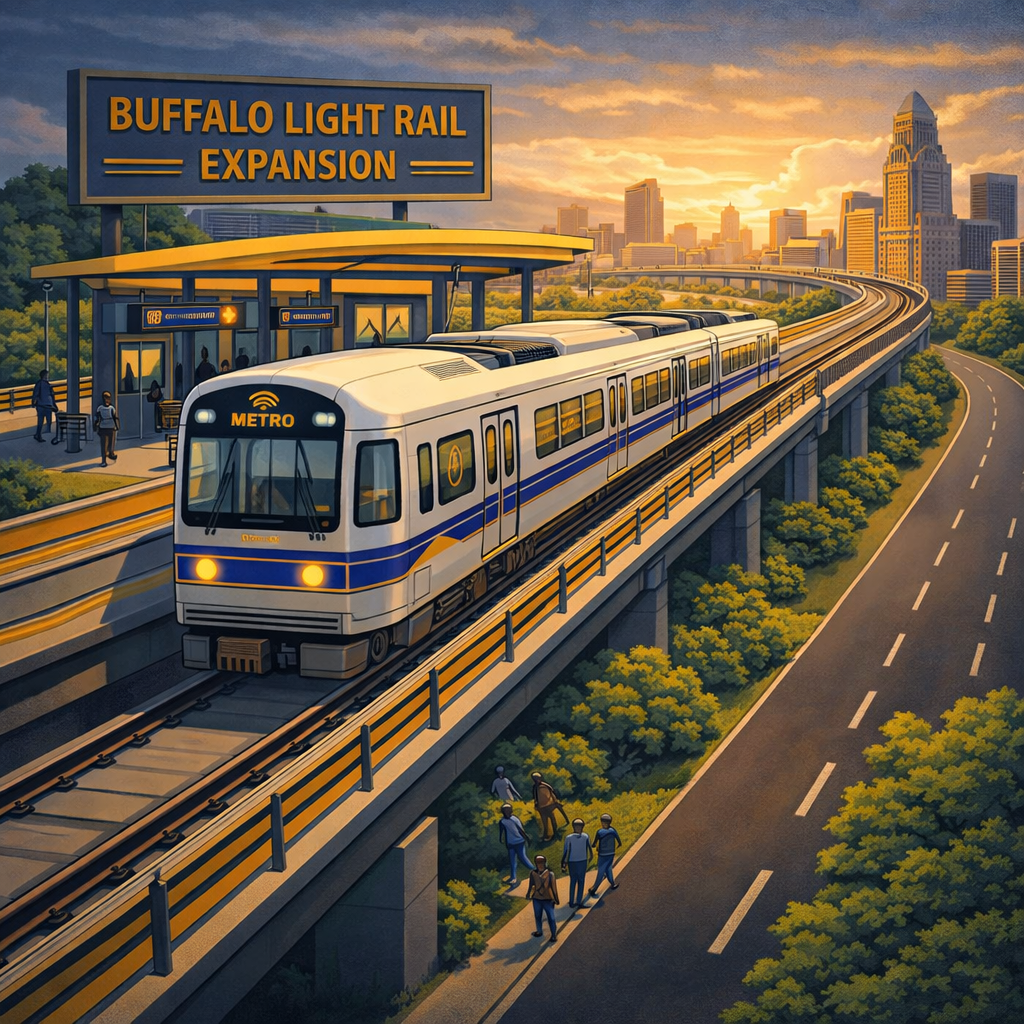
The Federal Transit Administration issued the final environmental impact statement and Record of Decision for the NFTA-Metro Transit Expansion Project in February 2026, formally selecting light rail as the preferred alternative for a 7-mile extension connecting UB’s North Campus to Buffalo’s downtown rail network. The milestone is genuine and hard-won. But the Capital Investment Grant (CIG) program, the primary federal funding mechanism for major transit expansion, is operating in a political environment that has shown consistent preference for highway investment over urban rail. The $1.2 billion project now enters a competitive funding queue of approximately a dozen major projects, in an environment where new CIG awards are politically uncertain at best.
The land use implication is the most time-sensitive dimension. Every year the project’s construction timeline is uncertain in a year during which Amherst and Tonawanda make development decisions along the proposed corridor – decisions that will either preserve transit-oriented development potential or foreclose it through car-dependent patterns. The rail extension’s funding fight and the land use decisions around its station areas need to happen in parallel, not in sequence.
Details
Last Updated:
4/2026
Main Drivers:
- Federal administration’s preference for highway investment over urban rail making new CIG awards politically uncertain
- Environmental clearance providing the most shovel-ready status of any major WNY transit project in decades
- Amherst and Tonawanda land use decisions along the corridor creating irreversible development patterns with or without rail certainty
- New York State’s transit capital budget capacity determining whether a state funding match can be assembled without full federal partnership
- UB’s North Campus growth trajectory creating a demand case for transit that will strengthen regardless of federal political cycles
Latest News: