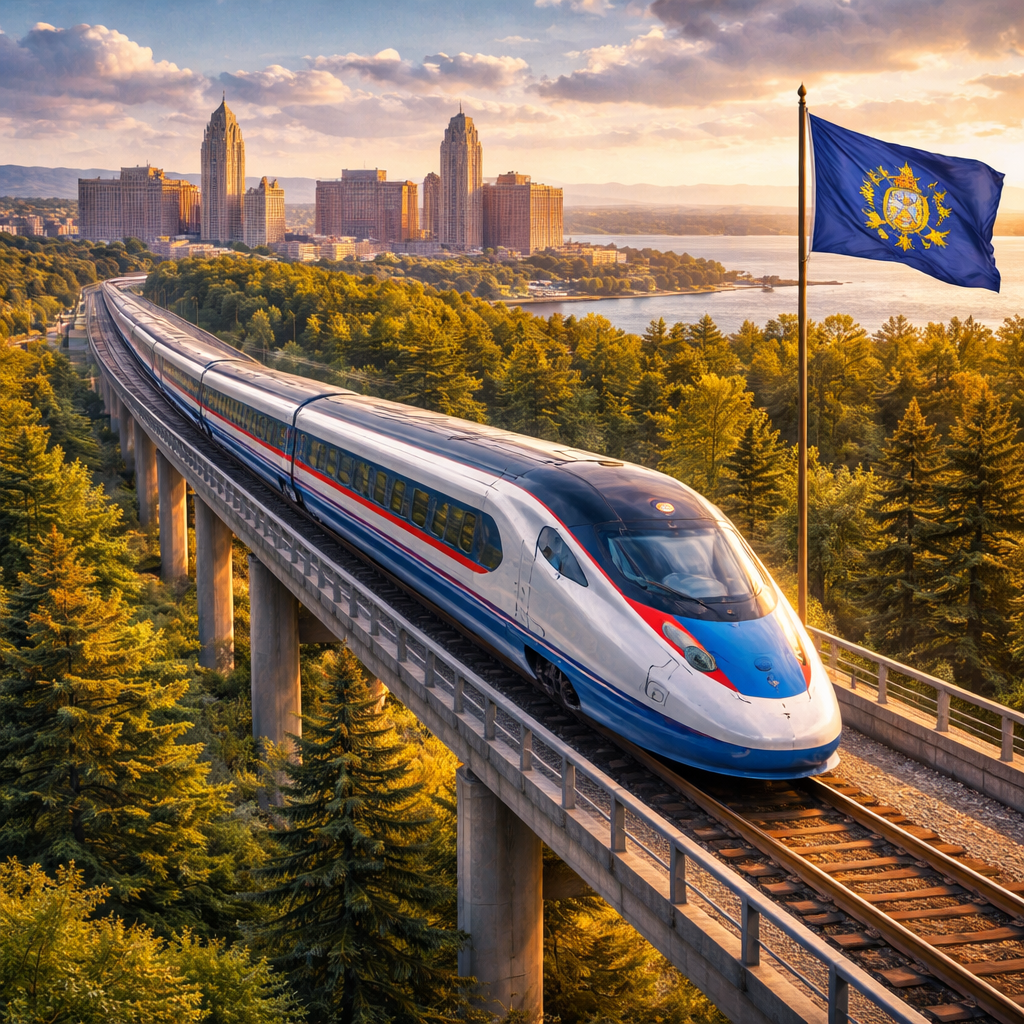
The United States has exactly one operating high-speed rail corridor: the Northeast Corridor, running from Boston to Washington, D.C. via New York. Everything else, including Amtrak regionals, Brightline Florida, and the Midwest routes, falls short of the 186+ mph threshold that defines true HSR by global standards. But two projects now under development are beginning to change the national picture in ways that carry real, if distant, implications for Buffalo. Brightline West (Las Vegas to the LA metro, ~200 mph, expected 2028–2029) will become the first privately built HSR system in U.S. history, proving that private capital can circumvent the governance fragmentation that has blocked public rail development for decades. California’s state HSR project, despite chronic delays and cost overruns, remains under active construction in the Central Valley and targets initial service in the early 2030s. Together, these projects are slowly stitching a West Coast rail future into view.
Buffalo’s connection to the East Coast picture is more immediate and more structurally grounded. The region sits squarely on the Empire Corridor: the Albany–Rochester–Buffalo–NYC axis, which has been the subject of upgrade proposals for years. More significantly, Buffalo is 90 miles from Toronto, which sits at the heart of Canada’s proposed Quebec City–Windsor high-frequency rail corridor, currently in advanced federal planning. If that Canadian corridor advances and a cross-border link becomes viable, whether via an upgraded Peace Bridge rail connection or new infrastructure, Buffalo would become the only American city with direct high-speed access to a Canadian HSR network. That’s a form of connectivity no other U.S. city can replicate, and it would reframe Buffalo’s geography from a regional endpoint to a genuine binational node.
The honest likelihood assessment: East Coast connectivity via an upgraded Empire Corridor is plausible within 10–15 years, slower trains running more reliably on improved track, rather than true HSR. A direct West Coast rail connection remains effectively zero on any meaningful planning horizon; the national network simply doesn’t exist yet to bridge that distance. The Toronto corridor is the sleeper scenario, with a lower profile in U.S. planning conversations but structurally the most realistic path to Buffalo gaining access to a true high-speed network within this generation.
Details
Last Updated:
3/2026
Main Drivers:
- Brightline West establishing a private-capital HSR model that could migrate to other corridors
- Canadian federal investment in the Quebec City–Windsor rail corridor passing through Toronto
- Empire Corridor upgrade funding through federal infrastructure legislation
- Growing congestion and climate pressure on aviation as the default long-distance travel mode
- Buffalo’s unique cross-border geography relative to every other mid-sized U.S. city
Latest News: